Almost every house with wood floors has a bottle of it somewhere. Restore, revive, shine, rejuvenate. The names vary and the mechanism doesn't. You mop it on, the floor looks noticeably better by the time it dries, and for a while you tell people it's the best twelve dollars you ever spent.
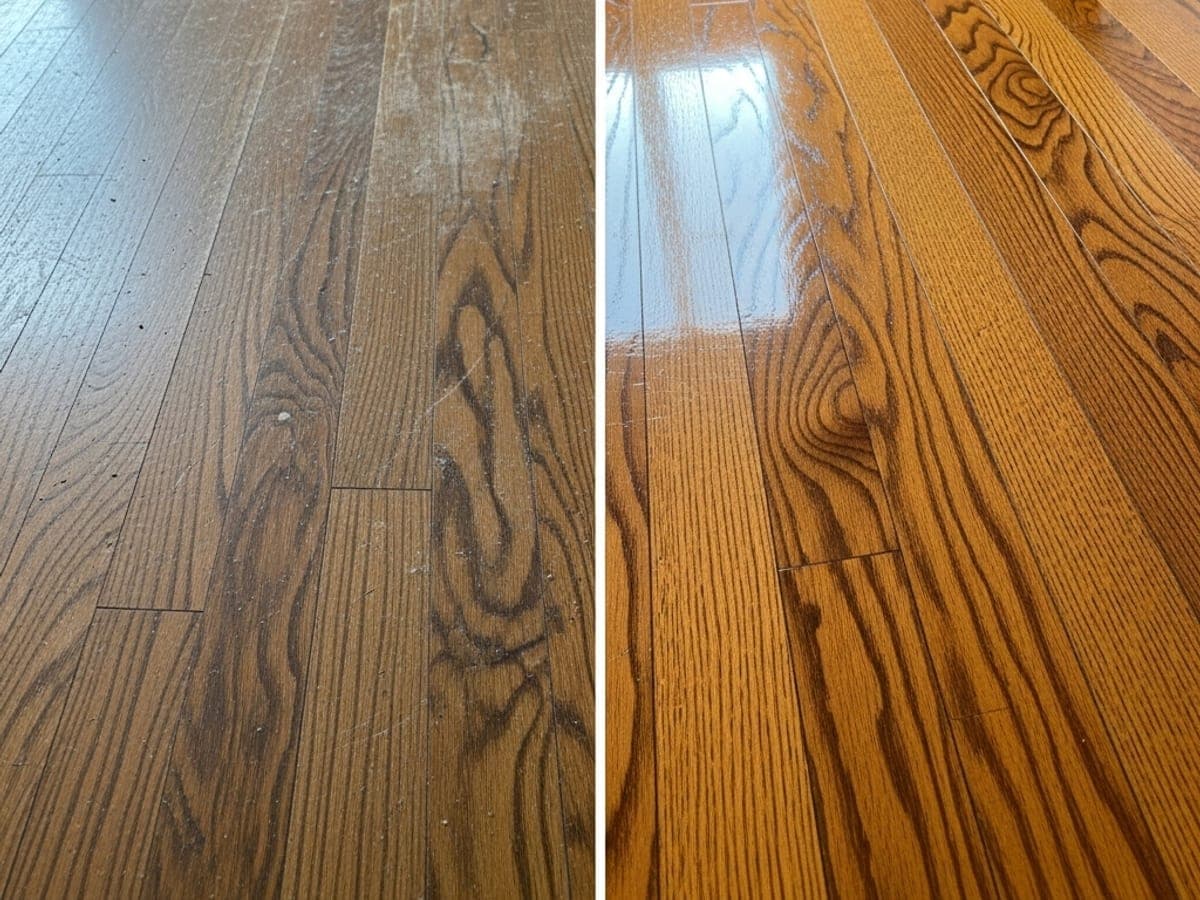
Then somewhere around the second or third year the floor starts looking worse than it did before you started. Cloudy in the hallway. Blotchy near the kitchen. A grayish haze that shows up worst in afternoon light. And the natural conclusion is that the finish finally gave out and it's time to call a refinisher.
It usually isn't the finish. It's the product.
The shine in the bottle is a plastic coat
Mop-and-shine formulas are built around acrylic or urethane polymers suspended in water. When you spread that mixture on a floor, the water evaporates and the polymer particles fuse into a continuous film. That film is smooth, so it reflects light cleanly, and your eye reads it as shine. Nothing was cleaned to produce that effect. Something was added.
This is a legitimate technology, and it's the same basic idea behind the floor finishes used in commercial buildings. The difference is that a commercial maintenance program strips the old coats off on a schedule before applying new ones. A homeowner with a bottle under the sink has no strip step. So the coats just accumulate.
Each coat locks in whatever was on the floor
A floor is never perfectly clean when you apply anything to it. There's fine dust, hair, a little grit, and some residue from the last product. When the polymer film forms, all of that gets embedded inside it instead of swept away.
Coat number one is thin and mostly clear and looks great. Coat four has three layers of trapped debris underneath it. Coat nine is a genuinely thick, slightly opaque plastic layer with years of house dust suspended in it, and the light coming off it scatters instead of reflecting. That's the haze.
There's also a wear problem. These coats are softer than the polyurethane finish underneath, so they scuff and abrade faster than the real finish would have. In the traffic lanes the coat is constantly being partly worn away and partly rebuilt, which is why hallways go blotchy first.
Why the mop tells you where the buildup is
Buildup follows the mop, not the feet. That gives you a diagnostic almost nobody thinks to use.
Look at a doorway between a room you clean weekly and a room you barely clean at all. A guest bedroom, a formal dining room, a closet. If there's a visible difference in clarity right at that threshold, with the well-cleaned side looking foggier, you have product buildup. Actual finish wear does the opposite. It concentrates where people walk, and it wouldn't care about a doorway that happens to be where you stop mopping.
The same logic applies under furniture. Pull back a rug that's been down for five years. If the floor under it is clearer and glossier than the floor around it, that gap is buildup, and it's removable.
Adding more never gets you back
The instinct when a shine product stops delivering is to apply it more often, and it's the wrong move for a specific reason. These products aren't solvents for themselves. A fresh coat contains just enough water to soften the top of the previous coat, which means it partly re-wets old embedded dirt and then seals it back in with a new layer on top. The floor looks improved that evening and slightly worse a month later, which is the pattern that keeps people buying.
Vinegar doesn't cut it either. It's too weak to dissolve a cured polymer, and diluted acid on a wood floor over years is its own slow problem. What actually removes these coats is a dedicated residue-stripping chemistry with enough dwell time to break the film, plus a way to lift the dissolved mess off the floor without spreading it into the next room.
Removing it is a water problem, not a scrubbing problem
Here's the awkward part about doing this yourself. To dissolve a multi-year polymer layer you need the solution to stay in contact with the floor for a bit. On tile that's easy. On wood, liquid sitting on the surface is exactly what you spend your whole life avoiding, because it finds the seams between boards and swells the edges.
That tension is the entire reason professional hardwood cleaning equipment exists. The machine meters out solution, works it into the film, and recovers it in the same pass, so the floor is wet for seconds instead of minutes and nothing pools in a seam. You can strip a small area by hand with a cloth and a lot of patience. Doing a whole house that way tends to end with a floor that's clean in patches, which looks worse than the even haze you started with.
What's underneath is usually fine
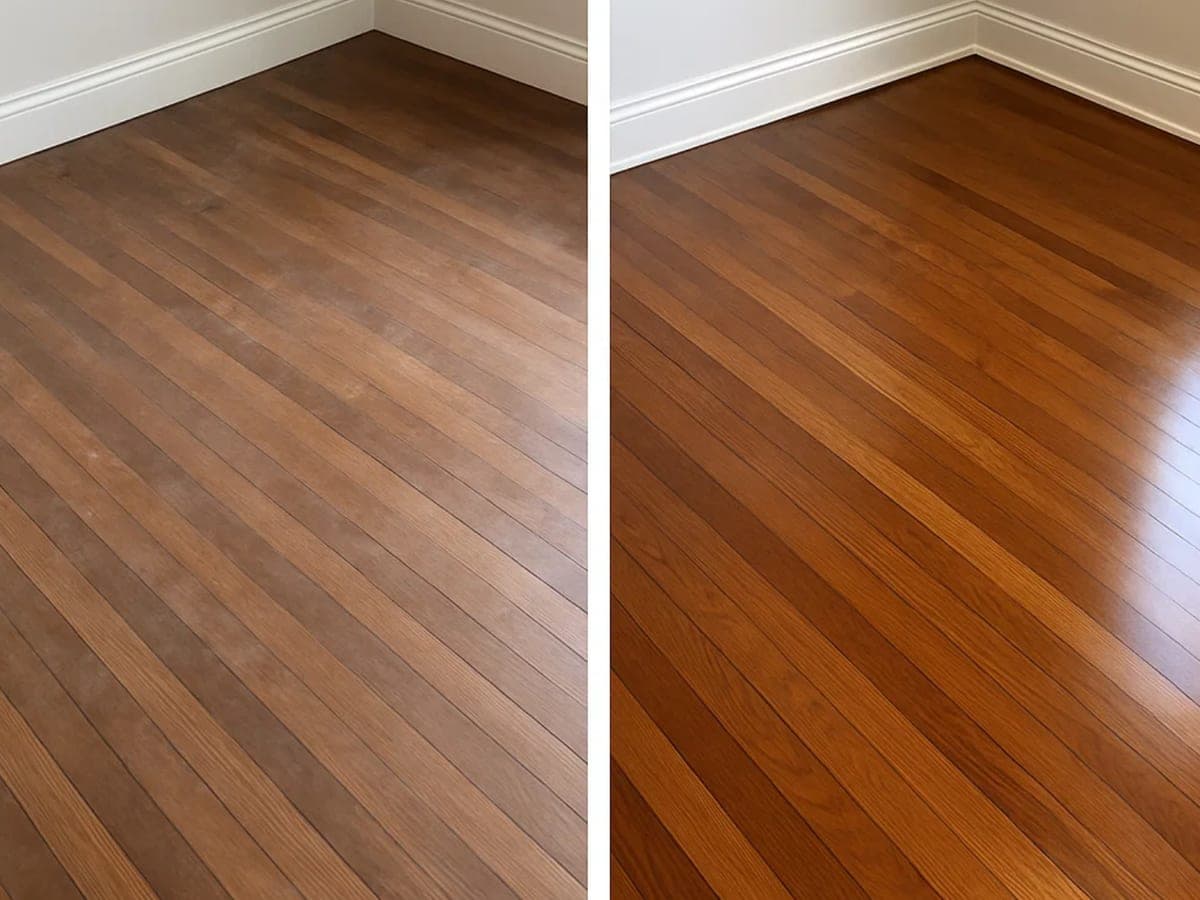
The part that surprises homeowners most is what the floor looks like once the layer comes off. The original finish has been sitting under a protective barrier of accumulated product this entire time, largely shielded from the grit and scuffing that would otherwise have worn it. It's frequently in better shape than the floor in a comparable house that never used these products at all.
Which means the years of shine product weren't a disaster. They were a sacrificial layer applied without a removal plan. Once it's off and a proper protective coat goes on in its place, you get the same benefit with a maintenance cycle attached to it.
If you're not sure which of those you have, the clean versus refinish page walks through three tests that take about ten minutes and will tell you which trade you actually need before anyone quotes you.