Commercial Hardwood Floor Cleaning
Offices, studios, boutiques, and dining rooms. Same process, faster cycle, scheduled around when your doors are closed.
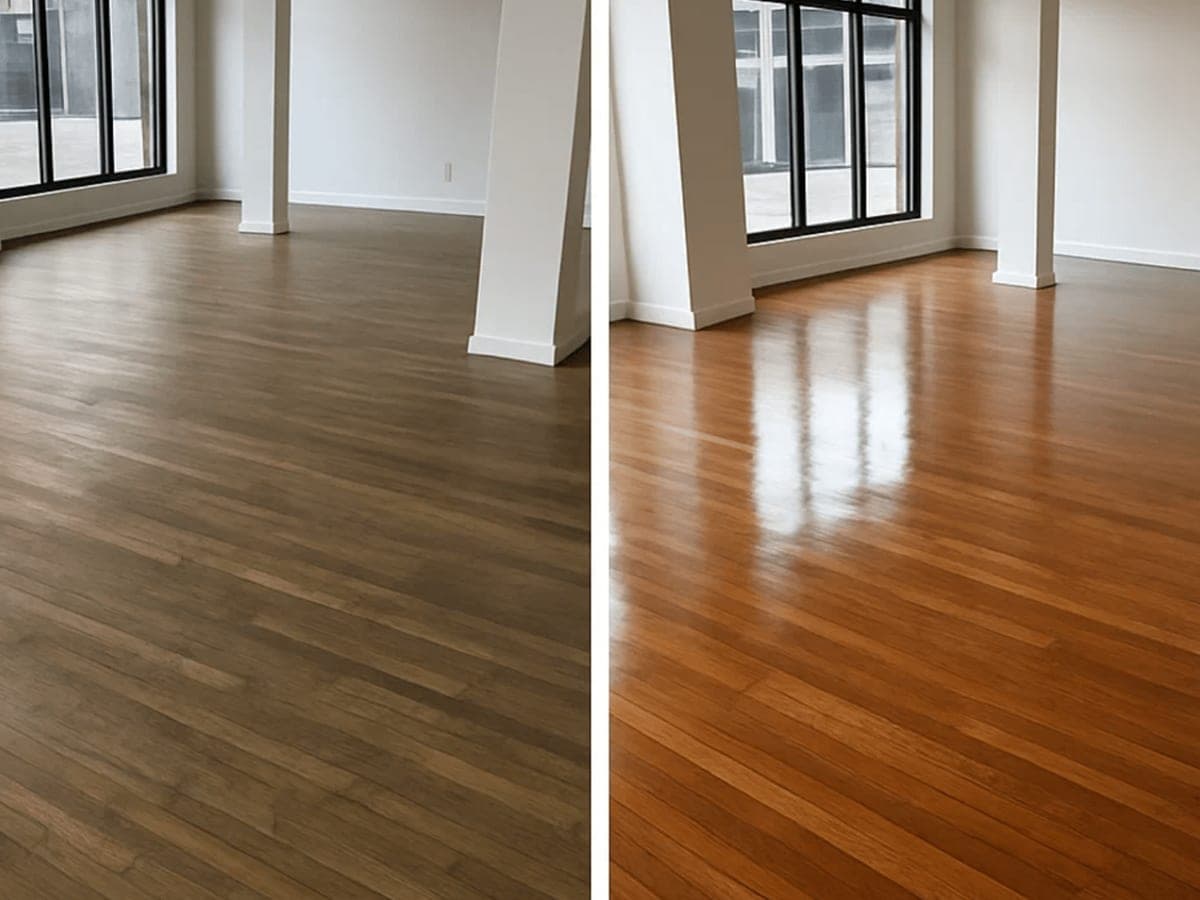
Wood floors in a commercial space run the same wear cycle a house does, just compressed. A retail floor can see more foot traffic in a week than a living room sees in a year, and the maintenance schedule that works at home is roughly four times too slow to keep up with it.
Why in-house cleaning falls behind on wood
Most commercial cleaning contracts were written around tile, carpet, and vinyl, and wood gets handled with whatever's already on the cart. That usually means an alkaline general-purpose cleaner and a wet mop, which is the combination that dulls a wood finish fastest. Six months of nightly service like that will visibly flatten a floor.
There's also a volume problem. A janitorial team mopping a large wood floor is moving the same bucket of solution across the whole space, so soil picked up in the entry gets deposited in the back. Over time that produces a uniformly dingy floor instead of a clean one, and nobody can point to when it happened. The third issue is that nobody owns the wood specifically. Carpet gets extracted on a schedule and tile gets machine-scrubbed on a schedule, and wood tends to get whatever's left. By the time somebody notices, there's a year of buildup and a traffic lane that's genuinely worn, not just dirty.
A busy retail floor can take a year of residential wear in a month. Same physics, different clock, which means a different schedule.
Commercial wear is the same physics on a shorter clock
The mechanism is identical to a house. Silica grit comes in on shoes, gets pressed into the finish, and abrades it. Residue accumulates from cleaning products. The only variable that changes is how many times per day it happens, and in a commercial space that number is one to two orders of magnitude higher.
The compression changes the economics. The chemistry stays the same. A residential floor cleaned every twelve to eighteen months stays ahead of the curve. A busy retail or restaurant floor on the same schedule falls behind, because the buildup polymerizes and the abrasion goes through the finish before the next visit comes around. Quarterly or semi-annual is where most commercial wood floors need to sit.
The entry gradient is more extreme too. In a house, grit falls off over the first few steps. In a store, hundreds of people repeat that same first-few-steps drop-off every day in exactly the same place, which is why commercial entries wear through in specific, predictable patches while the rest of the floor is fine.
How a commercial visit runs
We schedule around your operation, which usually means evenings, overnight, or whichever day you're closed. Dry time is thirty to sixty minutes, so a floor cleaned after close is ready to walk on well before opening. That's the practical advantage of a moisture-controlled process over anything that leaves a floor wet.
The process itself is the same one we run in homes. Controlled solution application, agitation, recovery in the same pass, then a water-based protective coat. In a commercial setting the coat is doing more of the work than it does at home, because it's absorbing a wear load that would otherwise go straight into the finish, and finish replacement in an occupied commercial space is expensive in downtime as much as in dollars.
For most spaces we'll suggest a recurring schedule and, where it makes sense, walk-off matting at the entries. Matting is unglamorous and it's the single highest-return change most commercial spaces can make to their wood floors, because it stops the abrasive before it reaches the finish.
We walk through the full moisture-controlled process on our how hardwood floor cleaning works page, and every job is backed by our 100% satisfaction guarantee.
Frequently asked questions
Can you work outside business hours?
That's how most commercial jobs run. Evenings, overnight, or a closed day. Dry time is thirty to sixty minutes, so a floor cleaned after close is walkable before you open, and there's no need to block off areas the following morning.
How often should a commercial wood floor be cleaned?
Quarterly for restaurants, busy retail, and studios. Semi-annually for offices and lower-traffic professional spaces. The schedule that works in a house is roughly four times too slow for a commercial floor, and falling behind is what turns a cleaning problem into a refinishing problem.
Do you handle restaurants and food service?
Yes, and those floors have the same grease chemistry a residential kitchen does at much higher volume. Airborne cooking oil settles and hardens into a film that ordinary nightly mopping won't touch, so dining rooms adjacent to open kitchens usually need the shortest cycle of anything we service.
Can you service multiple locations?
Yes. Safe-Dry® covers 532 service areas across six states, and multi-site accounts get coordinated through your nearest location. Start with the finder or call 1-800-SAFE-DRY and we'll route it.
Related hardwood floor problems we solve
Entryways & hallways
Grit tracked in from outside acts like sandpaper on the finish. Entries take the worst of it.
RoomsKitchen floors
Cooking grease plus foot traffic. The darkest, dullest boards in the house are almost always in front of the range.
ProblemDull floors, no shine
Sheen that's flattened out from residue, wear, or both. We test which one you have before quoting anything.
See the grain you paid for
Enter your zip code to reach your local Safe-Dry® team. We clean and protect hardwood across 532 locations in 6 states, with same-day appointments in most areas.