Hardwood Floor Cleaning in San Antonio, TX
San Antonio tap water comes out of limestone, and every mop bucket in this city leaves a little limestone behind.
The Edwards Aquifer is a karst system, which is a formal way of saying the water we drink has spent a long time dissolving rock on its way to us. It arrives loaded with calcium and magnesium, and by any standard measure it is hard water.
Nothing about that matters until you put it on a wood floor. Then the water evaporates, the minerals do not, and what is left behind is a thin white deposit that builds a little further with every mopping.
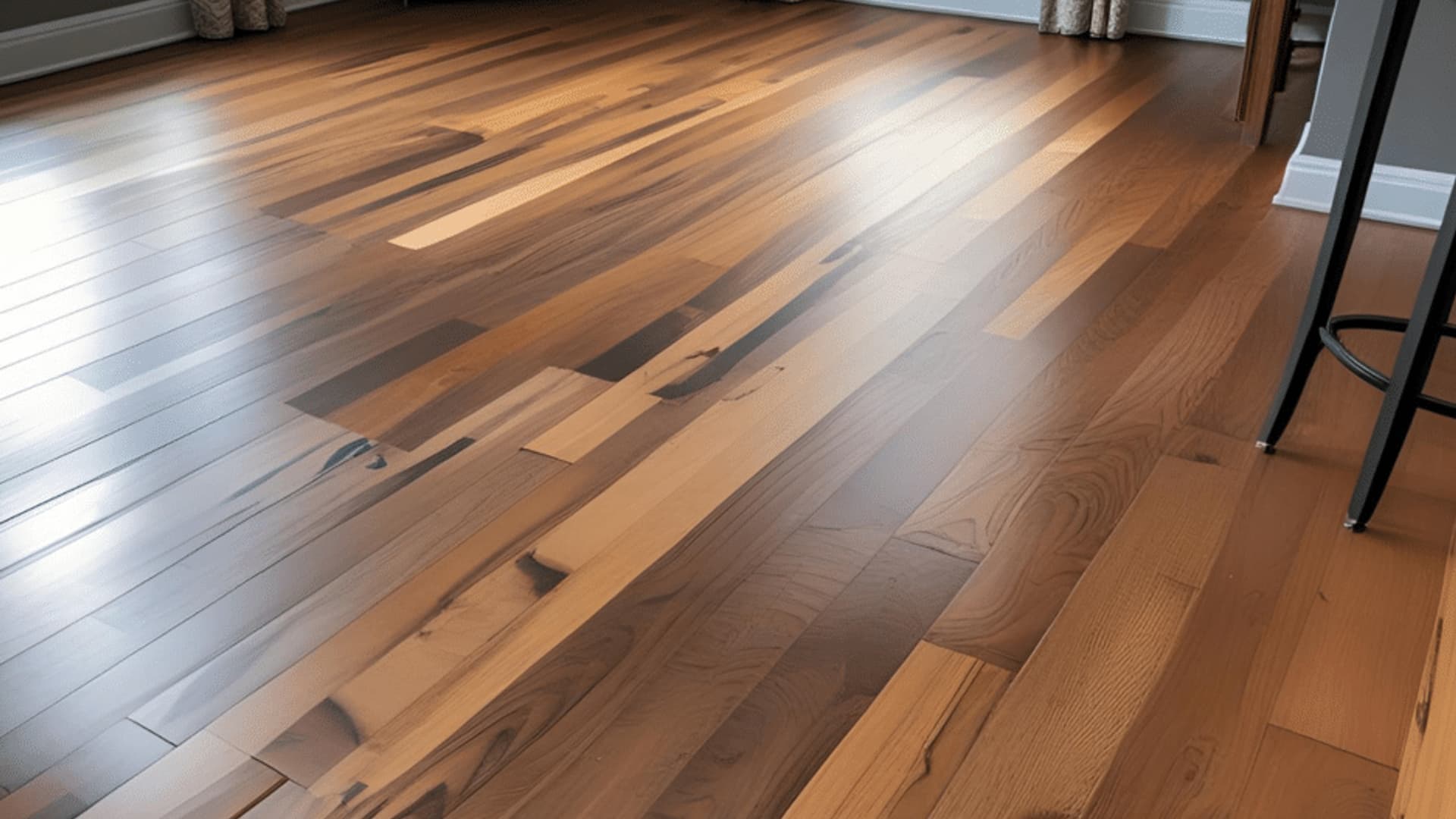
Which is why so many San Antonio homeowners describe the same thing: a floor that looks cloudy, will not come clean no matter how often it is mopped, and gets slightly worse each time they try.
Why the Cloudiness Gets Worse the More You Clean
A mop puts water on the floor and most of it evaporates in place. Whatever was dissolved in that water stays behind as a solid. Repeat the process weekly for a decade and you have laid down a mineral scale in slow motion, the same deposit you scrape off a shower door, except it is spread thin across an entire room and mixed with whatever cleaning product was in the bucket. It is not on the wood. It is on the finish, sitting between your eye and a coating that is very likely in good condition underneath.
Telling Mineral From Genuine Wear
Wear concentrates in traffic lanes and thins out toward the walls. Mineral deposit does the opposite. It is heaviest where you mop the most and where the water pooled and sat longest, so it is strongest in the middle of a room, under a kitchen sink, and in the corners a mop head could not lift out of. If your floor looks worst in places nobody walks, you are not looking at wear. Another check: put a drop of white vinegar on an inconspicuous patch, wait a minute, and blot it. If it lifts a spot of the haze, the haze is mineral. That is a diagnostic and it is not a treatment, since acid on a wood finish across a whole floor causes its own problems.
What Removing It Actually Takes
Mineral scale does not respond to more water, and it does not respond to a stronger detergent, since it is not a soil. It needs a chelating chemistry that binds the calcium and lifts it, applied in a controlled amount and recovered in the same pass so nothing runs into the board joints. That is the whole method here. The solution goes down metered, does its work, and comes straight back up. Once it is gone, the coating underneath reflects light again, and most people describe the result as the floor having got its color back when in truth it never lost any.
Same Water, Different Floors Across the City
A 1920s bungalow in Monte Vista or King William has original oak or pine with decades of wax and product on top of the mineral layer. A 2003 house in Stone Oak or off Borgfeld has engineered plank with a factory finish and a thinner veneer, so moisture control governs everything. A Castle Hills ranch is somewhere between the two. The deposit is identical in all three. What changes is how much can be taken off and how carefully. What none of them recover from is a gouge you can feel, a lane worn through to bare wood, black staining under an old pet accident, cupped boards, or veneer that has come apart. Machine-sanding a floor and laying fresh stain and polyurethane over it is somebody else's line of work, and we say plainly at the estimate when that is what a floor needs.
Not sure whether your floor needs cleaning or refinishing? There are three tests you can run yourself in about a minute, and they will tell you which one you are dealing with before anyone quotes you.
Hardwood problems we handle in San Antonio
Try the vinegar drop on a hidden corner tonight. If a clear spot appears, the problem is not your floor and it is fixable.
San Antonio: 210-460-2210, or book on this page. Fifty dollars off your first cleaning.
Areas we cover around San Antonio
Neighborhoods: Downtown, The Dominion, King William, Tobin Hill, Castle Hills, Alamo Heights, Stone Oak, Shavano Park, Hollywood Park, Monte Vista, Southtown, Olmos Park
Zip codes: 78201, 78202, 78203, 78204, 78205, 78207, 78208, 78209, 78210, 78211
Hardwood questions from San Antonio homeowners
Would a whole-house water softener have prevented this?
It would have reduced it. Softened water swaps calcium for sodium, which leaves less scale and its own faint film. Neither is a reason to mop a wood floor often.
Is distilled water a fix?
For prevention it works and it is what we suggest for anyone who insists on damp mopping. It does nothing about ten years of deposit already down.
Does the deposit damage the finish or just look bad?
Mostly it looks bad. The damage comes from people attacking it with abrasive pads and stronger chemicals, which is a very common story here.
How long does a whole house take?
Most single-story San Antonio homes are done inside a day, and you are on a finished room well before the crew has left the house.
Book online
Schedule your San Antonio hardwood floor cleaning
Prefer to talk it through first? Call 210-460-2210. Otherwise, pick a time below.
See the grain you paid for
Enter your zip code to reach your local Safe-Dry® team. We clean and protect hardwood across 532 locations in 6 states, with same-day appointments in most areas.